


Updated on
Onion Architecture and Clean Architecture follow the same rule: dependencies point inward, toward the domain. They differ in how they organise the code that obeys it. Onion arranges by layer. Clean arranges by use case.
That difference is small enough that most teams could adopt either. It shows up in one concrete place: in Clean Architecture a new feature is a new use-case class in an Application project, and in Onion it is a new method on an existing service.
We reach for Clean Architecture when the business rules are the hard part, and Onion wins outright when the layering is the hard part and the team wants fewer conventions. On a small application neither of them wins: both add projects, indirection and mapping that the codebase may never grow into.
What Is Onion Architecture?
Onion architecture is a type of layered architecture that can be visualized as a series of concentric circles, resembling the layers of an onion. Jeffrey Palermo first introduced this architecture to address the shortcomings of the traditional N-layered architecture approach.
There are various ways to segment the onion architecture, but there are some common layers:
- Domain Layer
- Service Layer
- Infrastructure Layer
- Presentation Layer
Conceptually, the infrastructure and presentation layers are considered to be at the same level in the hierarchy.
Let’s consider the hierarchy:
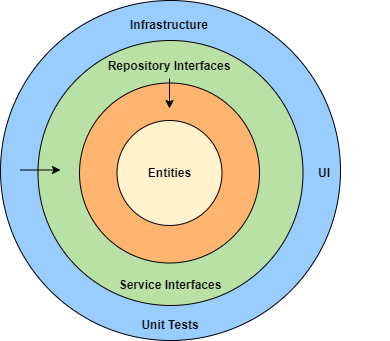
Notably, the outermost layers only depend on the inner layers, not the other way around. As we gradually ‘peel the layers of the onion,’ we expose the inner layers.
Onion is closely related to, but not the same as, the Hexagonal (Ports and Adapters) pattern. Alistair Cockburn published Hexagonal first, and Onion builds on it rather than renaming it.
Hexagonal surrounds the core of the application, the “hexagon”, with symmetric “ports”: the interfaces through which the application talks to the outside world. “Adapters” fit those ports and connect the application to external systems or frameworks. What Hexagonal does not do is order the inside of that core into ranked layers, and that ordering is what Onion adds. From here on we focus on onion.
Next, let’s look at the clean architecture pattern.
What Is Clean Architecture?
Clean architecture is a pattern focused on creating applications that are easy to maintain, as well as scale and test. Similar to the onion architecture, we achieve this by dividing things into layers with specific roles.
Let’s discuss the layers:
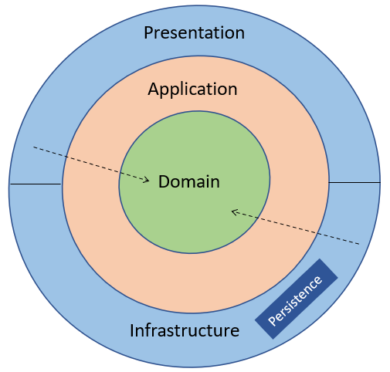
The domain layer, identical to the onion architecture layer, represents the core business rules and entities. It does not rely on other layers.
The application layer, positioned just outside the domain layer, acts as an intermediary, containing the use cases that expose the business rules. It only depends on the domain.
The infrastructure layer, again identical to the onion architecture, implements external services such as databases, file storage, and emails. It contains the implementations of interfaces defined in the domain layer.
The presentation layer, once again similar to the onion architecture, is responsible for handling user interactions and displaying data to the user interface.

A key principle here is that the dependencies flow inwards. This allows specific implementations to be changed in the future without impacting other parts of the application.
What Is Clean Code Architecture?
There is no pattern called “clean code architecture”. The phrase collapses two separate ideas by the same author: Clean Code, about how to write readable functions and classes, and Clean Architecture, about how to arrange dependencies between projects.
Clean Code is about the inside of methods and classes. Clean Architecture is about which project is allowed to reference which. They are independent: a textbook Clean Architecture solution can be full of unreadable methods, and a single-project console app can follow Clean Code to the letter.
Anyone searching the combined phrase almost always wants Clean Architecture: entities at the centre, use cases around them, adapters and frameworks on the outside, every dependency pointing inward.
If the real question is about naming, function length, and comments, that is Clean Code, and none of the layer diagrams on this page will help with it.
Clean Architecture vs Onion Architecture: What Is the Difference?
The dependency rule is identical in both. Robert C. Martin states it as “source code dependencies can only point inwards”, and Jeffrey Palermo’s Onion post says the same thing: “all coupling is toward the center”.
The difference is what sits around the centre and what the layers are named after. Onion organises by layer: a domain core, then services, then infrastructure and presentation around it. Clean organises by use case: entities at the centre, an application layer that names each thing the system does, then interface adapters, then frameworks.
In a solution that shows up immediately. A Clean Architecture core has an Application project full of use-case handlers. An Onion core usually has service interfaces and implementations grouped by entity instead.
The consequence worth remembering is where new behaviour goes. In Clean Architecture a new feature is a new use-case class. In Onion it is a new method on an existing service.
The two overlap heavily, and not only in our reading of them: Microsoft’s .NET architecture guidance presents Hexagonal, Ports-and-Adapters, Onion and Clean as names the same architecture has gone by. Clean Architecture is in practice a more explicitly layered variant of Onion, and both rest on dependency inversion, so the outer layers depend on abstractions declared further in.
First, let’s highlight the dependencies that each project depends on, in the two different architectures, starting with Onion Architecture:
| Layer | Project | Depends On |
|---|---|---|
| Presentation | API | Everything |
| Infrastructure | Persistence | Domain |
| Core | Services.Abstractions | Contracts, Domain |
| Services | Contracts, Domain, Services.Abstractions | |
| Contracts | Domain | |
| Domain | N/A |
Now, let’s look at the dependencies in Clean Architecture:
| Layer | Project | Depends On |
|---|---|---|
| Presentation | API | Everything |
| Infrastructure | Infrastructure | Domain |
| Persistence | Domain | |
| Core | Application | Domain |
| Domain | N/A |
Although our applications have a different number of projects, the principles have remained the same. Core layer projects only rely on each other (i.e. within the same layer). Infrastructure layer projects only rely on the domain layer while the presentation layer projects rely on all other layers.
So in terms of dependencies, there is no difference in the patterns. The outermost layer depends on the inner layers. This is the core principle behind both patterns, and both achieve it with the dependency inversion principle in C#.
Neither pattern enforces itself. The compiler is happy to let a domain project reference a database driver, so if the direction matters to us we should be enforcing these layer rules with architecture tests that fail the build when a reference points the wrong way.
Project Structure of the Core Layer in Onion and Clean Architecture
In the onion architecture, our core layer is organized with a set of projects:
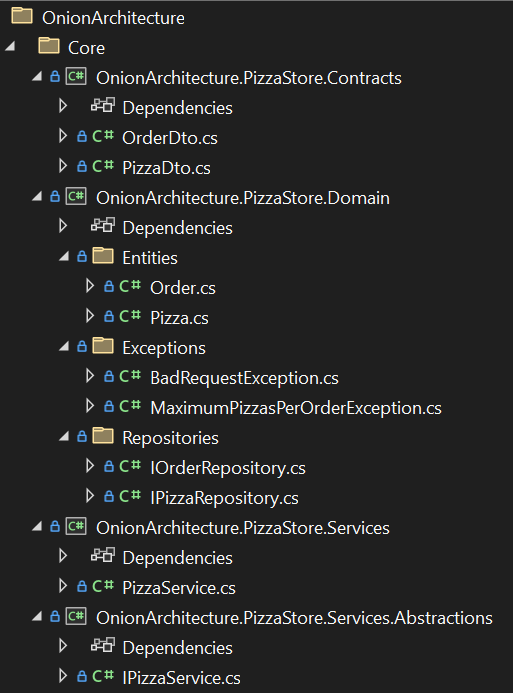
We have our domain or business entities, our exceptions, our repository interfaces, and our service interfaces/implementations. Additionally, these components are integral to the architecture. Notice everything is organized around “Pizza” and “Orders”.
Let’s look at our core layer in the clean architecture solution:
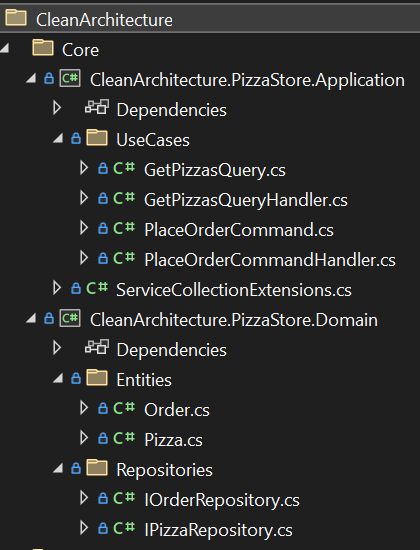
So we have entities again, and repository interfaces again. Nothing new there. But notice the CleanArchitecture.PizzaStore.Application project. It contains specific use cases, that we want the application to fulfill.
This is where one of the key differences in the patterns emerges. The clean architecture pattern attempts to organize code around use cases and has a real focus on business logic. The emphasis is placed on explicitly defining these use cases.
Once that Application project exists, the next question is what a use case looks like inside it. A common answer is one request and one handler per operation, which is organising the application layer with CQRS and MediatR.
In other words, while the onion architecture focuses on the layers and the flow of dependencies, clean architecture focuses on organizing the application around use cases, whilst still maintaining the same dependency principles.
Clean architecture prioritizes business rule independence through a concentric layering of entities, use cases, and adapters, while onion architecture revolves around a central domain model with layers structured around it to maintain a clear separation of concerns and facilitate flexible dependency management.
How to Decide Which Pattern to Use?
Choose Clean Architecture when the business rules are the hard part, and Onion when the layering is.
Clean Architecture’s extra ceremony (a class per use case) pays for itself when the domain is genuinely complex, when several entry points share the same behaviour, or when the team needs the rules of engagement written down where a new joiner can read them.
Onion is the lighter of the two. It gives the same dependency direction with fewer classes per feature and fewer conventions, which suits an experienced team working on a well-understood model where most operations are ordinary reads and writes.
For a small application, neither. Both add projects, indirection, and mapping to a codebase that may never grow into them.
Whichever we pick, the part worth defending in review is the dependency direction. The layer names are negotiable.
| Onion Architecture | Clean Architecture | |
|---|---|---|
| Introduced by | Jeffrey Palermo | Robert C. Martin |
| Organising idea | Concentric layers around a domain core | Use cases around entities |
| Core projects, typically | Domain, Services (interfaces and implementations) | Domain/Entities, Application (use cases) |
| Where a new feature goes | A new method on an existing service | A new use-case class |
| Dependency direction | Inward | Inward |
| Achieved by | Dependency inversion | Dependency inversion |
| How prescriptive | Looser: layer names vary by team | Stricter: named layers with defined roles |
| Number of projects | Six in our sample, not counting tests | Five in our sample, not counting tests |
| Closely related to | Hexagonal / Ports and Adapters | Screaming Architecture, Clean Code (different idea) |
| Choose it when | Clear structure and separation are the priority | Business rules are complex, or several entry points share behaviour |
| Skip both when | The application is small enough that folders will do | Same |
“Introduced by” attributions read on 13 September 2026 from Jeffrey Palermo’s The Onion Architecture: Part 1 and Robert C. Martin’s The Clean Architecture.
When a single application grows several largely independent business areas, the next decision is not Onion against Clean but whether to split it at all, and the modular monolith is the usual first answer.
Structure & Flexibility
Like any architectural pattern, we are often trading off simplicity. So only use one of these patterns if we believe the application will grow with business needs and resources. However, between the two patterns, if the priority is complex business logic, clean architecture is the best choice. If the priority is around clear structure and layers, onion might be a better choice.
Skill
Because clean architecture strictly adheres to its guidelines, it might suit teams accustomed to such rules. This structure helps new developers integrate easily and reduces the chances of breaking established patterns. However, this adherence comes at the cost of flexibility. For experienced teams that understand and can maintain the focus on layers but prefer more flexibility, the onion architecture may be a better choice.
Maintenance
Clean architecture makes it easy to keep different business areas separate and extend them by explicitly exposing functionality through use cases, much like vertical slice architecture. On the other hand, onion architecture provides a clearer separation of concerns, which means it’s easier to extend the overall application.
Conclusion
In this article, we took a closer look at the onion and clean architecture patterns. Specifically, we examined their respective approaches to software design. Although very similar, we highlighted some nuances that can help us decide which one to choose when building our next application. Like with any architectural decision, it’s important to understand all the trade-offs as well as the reason behind applying the pattern. Hopefully, this article has helped to make that decision in the future.
Happy coding!
Tested with .NET 10.0.10.